
Published April 16, 2026
During a recent trip to Nepal, Emilia Emerson, a PhD student in MSU’s Department of Biosystems & Agricultural Engineering, came down with a gastrointestinal illness. Ironically, she was hospitalized in the same facility where she had previously collected wastewater samples for her research.
“That was interesting,” Emerson recalled. “To be characterizing a hospital’s wastewater and then end up going there.”
She would experience firsthand the risks her research aims to prevent, giving her a new perspective on the importance of wastewater monitoring for public health.
Research that began during her master’s has now taken Emerson to Nepal and Thailand for an international collaboration with Professor Bim Prasad Shrestha with the Nepal Technology Innovation Center (NTIC) at Kathmandu University, and professors Panmanas Sirisomboon and Thitima Phanomsophon at King Mongkut’s Institute of Technology Ladkrabang (KMITL) in Thailand. The project involves wastewater quality monitoring using miniaturized near-infrared (Micro-NIR) spectroscopy.
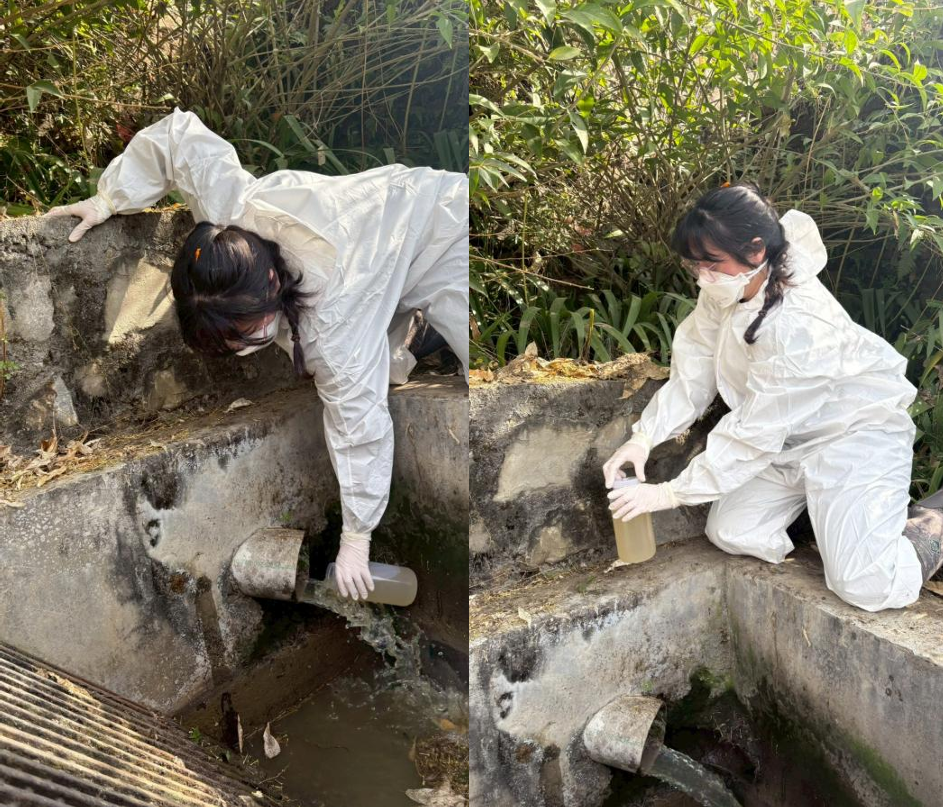
Emilia collects wastewater from a sewer outfall.
“Micro-NIR spectroscopy is a rapid, non-invasive form of analysis that can provide real-time monitoring for a variety of sample types,” Emerson explained. “It works through molecular vibrational excitations that are specific to certain chemical bonds—things like lipids, starches, and moisture.”
This technology can identify what materials are made of by examining how their molecules vibrate when exposed to light. And because Micro-NIR works quickly, researchers can track potential public health risks immediately rather than waiting for lab results.
Applying Micro-NIR to wastewater
Micro-NIR spectroscopy hasn’t traditionally been used to monitor wastewater because of water’s strong ability to absorb near-infrared light. This creates an interference that can disguise key indicators of contamination. Likewise, wastewater contains millions of contaminants and microorganisms that, until recently, NIR tools have struggled to measure.
More commonly used in agriculture to analyze crops and soil health, Micro-NIR is being explored by Emerson and her partners for application in wastewater.
The team has targeted three distinct wastewater streams: municipal (sampled from a treatment plant in Michigan), hospital (from facilities in Nepal), and industrial (from a latex factory in Thailand).
The collaboration combines KMITL’s expertise in Micro-NIR and data monitoring, Emerson and the MSU Liao lab’sknowledge of wastewater and sampling protocols, and Kathmandu University NTIC’s testing of the approach within Nepal’s developing wastewater systems.
Different systems present different challenges
Wastewater systems can vary widely from one country to the next for economic, geographical, and technological reasons, among other things. In the U.S., wastewater treatment has been guided by decades of mandated standards established during the Clean Water Act of 1972. This act regulated the discharge of pollutants into navigable waterways without a permit, and provided billions in federal funding for the construction of wastewater treatment plants.
In Thailand, formal wastewater management took shape during the 1990s with the establishment of the Wastewater Management Authority (WMA). This group designs, builds, and maintains wastewater treatment systems in the Lower Chao Phraya River Basin.

Emilia (back left) has lunch with researchers from KMITL.
“Thailand has the infrastructure and wastewater discharge standards, so they’re further along in the process than Nepal,” Emerson said. “…Both the U.S. and Thailand are lending a hand with our experience and best practices.”
Over the last 20 years, Nepal has introduced wastewater discharge standards, but much of the country still lacks adequate wastewater infrastructure. According to a 2024 article, only about 2-3% of total urban wastewater generated in Nepal is effectively treated. The remaining majority is discharged directly into natural bodies of water.
“There’s a huge push by both the government and universities in Nepal to implement [emphasis added] these standards,” Emerson said. “They really want to focus on installing the infrastructure, but there are challenges around operating and maintaining those systems.”
That’s where this collaboration comes in.
Early findings
This project is still in the early stages of applying Micro-NIR to wastewater quality monitoring, but the team is beginning to see how differently municipal, hospital, and industrial wastewater behaves—and the challenges that can create.
“In our preliminary results, we’ve found that in order to predict water quality from the NIR spectral footprint, we’ll need to create a separate model for each type of wastewater,” Emerson said. “Because they’re all so different.”
Beyond the technical challenges, working with researchers in Nepal and Thailand has changed how Emerson thinks about wastewater more broadly.
“Before I started to study wastewater, I didn’t really think much about it in the U.S.,” she said. “You use the tap, do laundry, or flush the toilet, and it all goes away; you never see it again. So I think we tend to forget how important it is to our lives. Modern sewage is significant to our quality of life, but there are places around the world where it’s not readily available. I think it’s important to think about the ways, as scientists, we can contribute our best practices and our knowledge to places where this everyday thing for us isn’t always available.”
Story by Aja Witt