
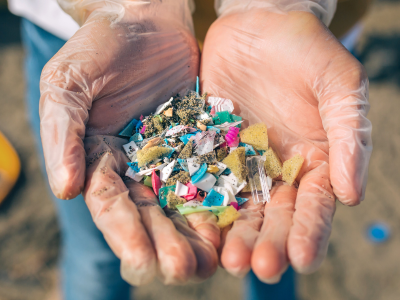
About the Plastics and Health Consortium (PHC)
Get Involved
- Visit the MSU Water Alliance Member Directory to identify researchers involved with the MSU PHC.
- Reach out to Assistant Professor Yoorae Noh (nohyoora@msu.edu) or Ellie Sibula (sibulael@msu.edu) if you are interested in participating in the consortium.
An upcoming opportunity to network and discuss plastic pollution is the virtual Great Lakes Microplastics Summit hosted by the Department of Environment, Great Lakes, and Energy Oct. 7-8, 2026.
In the News
Microplastics Legislation
Microbeads: HB 4766 & SB 503
This proposed legislation would ban the use of microbeads (a type of microplastic) in Michigan, going beyond the scope of the federal Microbead-Free Waters Act of 2015. It addresses pollution from both industrial sources and everyday household products that contribute to microplastic contamination. Starting in 2026, the bill prohibits the manufacture and sale of materials containing microbeads that are likely to enter Michigan’s waterways. By 2027, personal care and cleaning products such as scrubs, soaps, and air fresheners containing microbeads will also be banned, with limited exceptions. These intentionally added microplastics are too small to filter out and pose a growing risk to public health and the environment.
Strategy: HB 4767 & SB 505
This bill requires the Michigan Department of Environment, Great Lakes, and Energy (EGLE)to develop a comprehensive statewide research and monitoring plan for microplastics in the Great Lakes with contracts through other institutions. The plan will assess the presence of microplastics in the environment and the Great Lakes ecosystem to evaluate the ecological, health, and economic impacts. Where feasible, sources and pathways of microplastics pollution will be identified and mitigation solutions will be proposed through policy interventions, education, or other efforts. It also calls for identifying sources and pathways of microplastic pollution, proposing solutions such as source reduction, public education, and policy recommendations.
Drinking Water: HB 4768 & SB 504
This legislation would require the Department of Environment, Great Lakes, and Energy (EGLE) to create a statewide microplastics monitoring program focused on public drinking water supplies. EGLE must conduct quarterly testing using scientifically recognized methods to establish baseline levels of microplastics and assess any potential health risks. Monitoring must include a variety of water sources, such as the Great Lakes, tributaries, and inland lakes. The department is also required to compile and publicly share a detailed report summarizing findings including; microplastic characteristics, and potential sources, recommendations for risk assessment, toxicity thresholds, and future monitoring or mitigation actions.
State & Federal Action
Whitmer joins Democratic governors calling on the EPA to monitor microplastics in drinking water
Relevant Publications
Examining Misconceptions about Plastic-Particle Exposure from Ingestion of Seafood and Risk to Human Health (2025)
Plastic particles are widespread in the environment, but public concern about their presence in seafood has been driven more by media narratives than scientific evidence. Available data show that plastic particle levels in seafood are comparable to those in other foods, and that human exposure is far greater through indoor air and dust than through diet, with minimal evidence of dietary toxicity or health risk. The disproportionate focus on seafood contamination in scientific media is unjustified and risks misleading the public and discouraging the well-documented health benefits of seafood consumption.
Read the full article here: https://pubs.acs.org/doi/10.1021/acs.estlett.5c00551
The potential effects of microplastics on human health: What is known and what is unknown (2021)
Microplastics are pervasive across aquatic, terrestrial, and atmospheric environments, and humans are exposed through food, drink, and inhalation, yet direct evidence of impacts on human health remains limited. Most existing research relies on model organisms, with human health implications inferred rather than clinically demonstrated. While correlative studies and experimental models suggest potential immune, stress, reproductive, and developmental effects, more rigorous human-focused research is needed to determine actual health risks.
Read the full article here: https://pubmed.ncbi.nlm.nih.gov/34185251/
Conferences & Symposia
The 2024 Science Symposium – Plastic Recycling & Chemical Contaminants in Recycled Plastics featured presentations on contaminant composition, regulatory considerations, and advanced recycling methods, followed by a panel discussion with industry and academic experts.
Presentations:
Recycling and contamination, Anne Germain, Chief Operating Officer & Senior Vice President of Regulatory Affairs for the National Waste & Recycling Association
Composition of Extractable Chemicals in Recycled Polyolefins, Greg Curtzwiler, Assistant Professor, Iowa State University
Regulatory Considerations for the Use of Recycled Plastics in Food Packaging, Sean Fischer, Regulatory Review Scientist, U.S. Food and Drug Administration
Polymer Recycling and Contaminant Removal from Multilayer Plastic Packaging by Solvent-Targeted Recovery and Precipitation, Reid Van Lehn, Hunt-Hougen Associate Professor, University of Wisconsin-Madison