
Greg Rouland is a PhD student in the Department of Biosystems & Agricultural Engineering. He joined the WaterCube NRT Fellowship Program in 2025, drawn to its emphasis on collaborative research and a wide range of perspectives on water.
Greg's research uses advanced sensing technologies to improve land use and wastewater management. Using a machine called the tTEM, or Toad Transient Electromagnetic Method, he collects data on soil resistivity across fields, which helps to determine where wastewater can be applied most effectively.
“It’s a machine towed by an ATV (all-terrain vehicle) that we can drive over a field, and it’ll send out signals into the ground, generating a response which is then measured,” Greg said. “What that allows us to do is see the resistivity of the soil, how much, and at different levels, it’s resistant to the flow of electricity.”
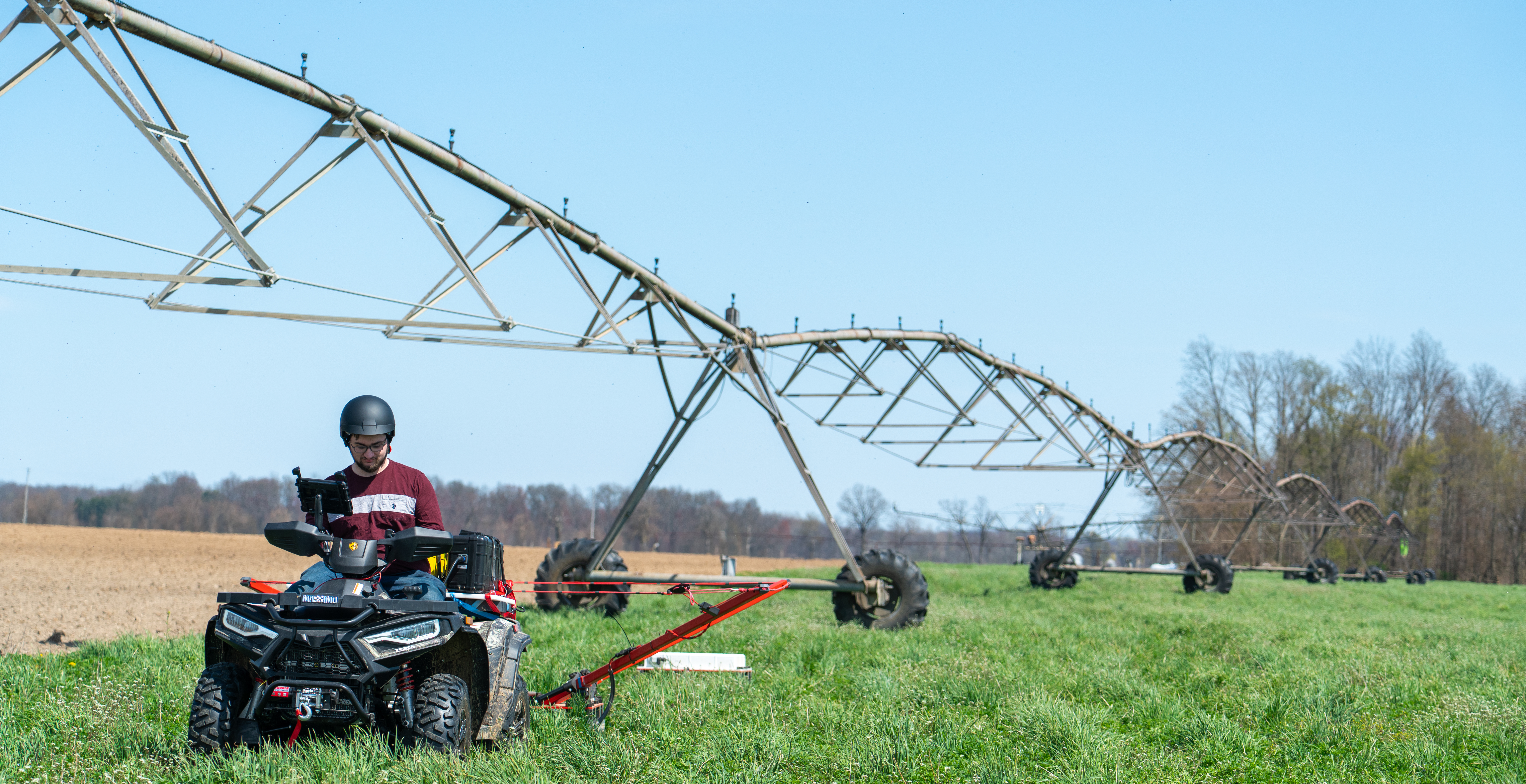
Greg driving the tTEM unit out for a field survey.
The goal is to map the 3D structure of soil, identifying variations like sandy or clay-rich areas that would affect water flow and treatment outcomes. “This technology helps us to understand where in a field wastewater will behave differently, which is critical for proper land application and environmental protection,” he explained.
In addition to the tTEM work, Greg has been evaluating coagulants and natural flocculants for wastewater treatment, including a shrimp-shell-derived option that he compared to traditional alum, a common chemical used to help particles clump together so they can be removed from wastewater. This was the focus of his summer 2025 research, producing experimental results that will inform an upcoming publication.
WaterCube’s interdisciplinary approach has influenced how Greg thinks about his own work. “Being exposed to perspectives from sociology, geography, and environmental policy has made me step back and think beyond the immediate science,” he said. He noted that coursework and seminars offered through the program have helped him consider factors like economic feasibility and community impacts alongside technical outcomes, providing a more holistic view of water management.
Greg expressed his appreciation for the networking and collaborative opportunities within WaterCube NRT. The program’s support for internships and international experiences offers him the chance to apply his skills in real-world and global contexts.
For those considering applying to WaterCube, Greg emphasizes the program’s flexibility and focus on professional development. “Compared to other grants and fellowships, this one is especially supportive. It’s tied to your growth as a researcher, not just a single project,” he said. Through his participation, Greg continues to deepen his expertise while contributing to a collaborative, innovative community tackling complex water challenges.