

Rui Li attends the CANVAS science conference.
Rui Li is a PhD student in the Department of Plant, Soil and Microbial Sciences. She joined the WaterCube NRT Fellowship Program in 2025 after learning about it from her advisor, Professor Wei Zhang.
Rui's research uses machine learning to study soil and crop systems. She investigates how soil properties, plant growth, and environmental conditions affect the movement and absorption of herbicides and other chemicals in farmland, with implications for food safety. Using predictive models, which can later be visualized as maps, she estimates how contaminants like PFAS (per- and polyfluoroalkyl substances, or human-made “forever chemicals”) are transferred from soil into crops. These predictions can help farmers make safer planting decisions.
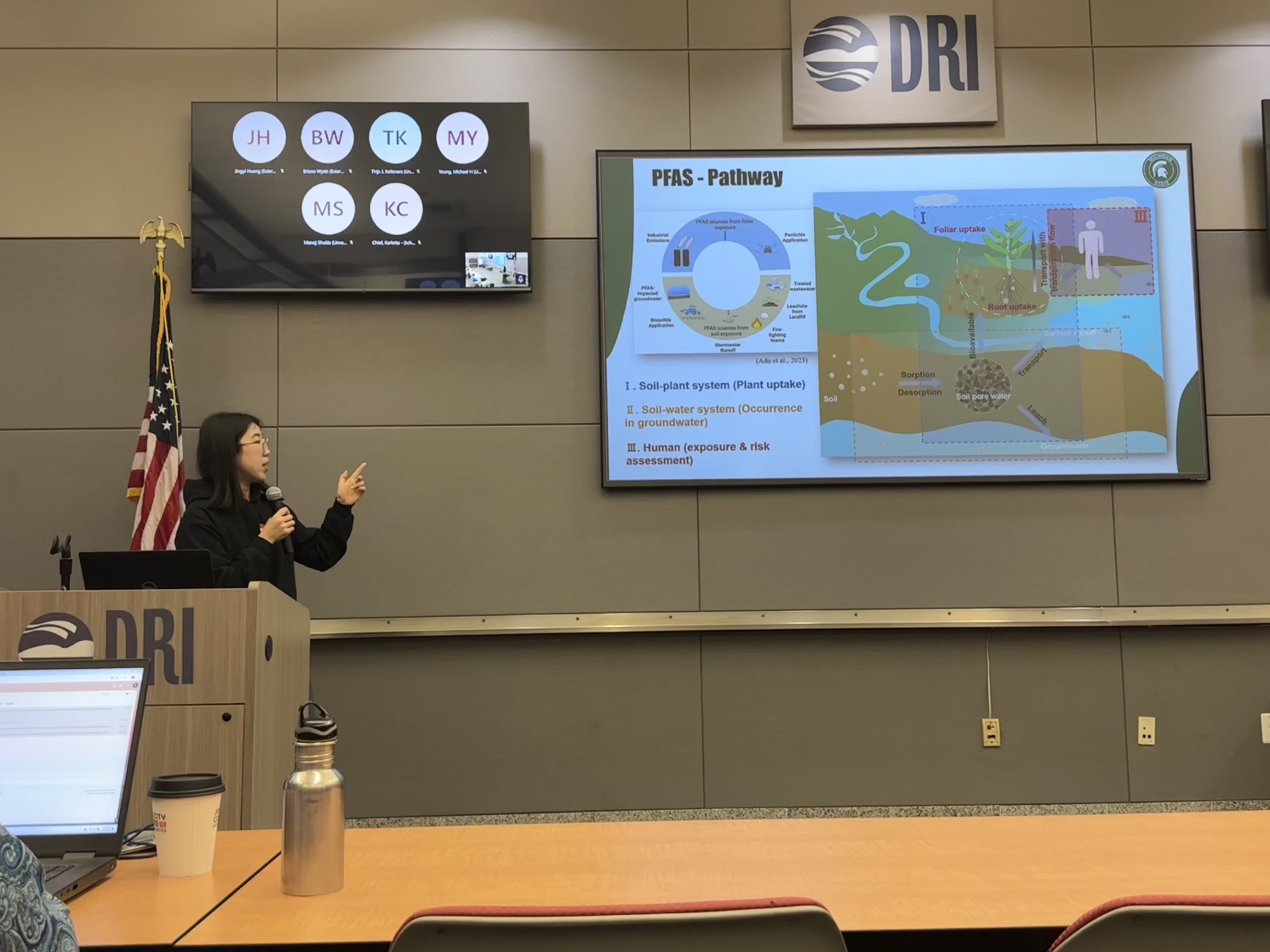
Rui presents on modeling the fate and transport of environmental contaminants.
“My research isn’t directly tied to water, but understanding water flow is key to building the map and predicting chemical movement,” Rui explained. “I look at soil, the crops, and the environment to see how contaminants are absorbed.”
Water movement drives the transport of chemicals through soil and into crops; this informs Rui's predictive models and the map she is building.
Rui is still early in her experience as a WaterCube trainee but values learning from peers in different disciplines, namely social science, to include broader perspectives in her work. “At first, I felt a little lost when we discussed social science approaches, like collecting data from people,” she said. “I’m a soil person, not a people person, but I want to learn from my cohort and professors to integrate social science into my research.”
Rui is looking forward to gaining additional experience in data-driven research methods through upcoming seminars and conferences. She hopes to build her expertise in machine learning and interdisciplinary approaches to agricultural and environmental challenges.