
Marinna Guzy is a PhD student in the Department of Fisheries and Wildlife with a dual major in Environmental Science and Policy. She joined the WaterCube NRT in 2025 after first encountering the program during coursework on global water issues.
One aspect of Marinna's research focuses on building relationships with the Bay Mills Indian Community to better understand community members’ perceptions of Great Lakes fisheries and climate change. Her work involves reading tribal histories, learning about Indigenous research methodologies, and attending community events, including powwows and the Superior Whitefish Festival in July.
Rather than beginning with predefined research questions, Marinna's approach prioritizes listening, trust-building, and learning what research, if any, would be most useful to the community.
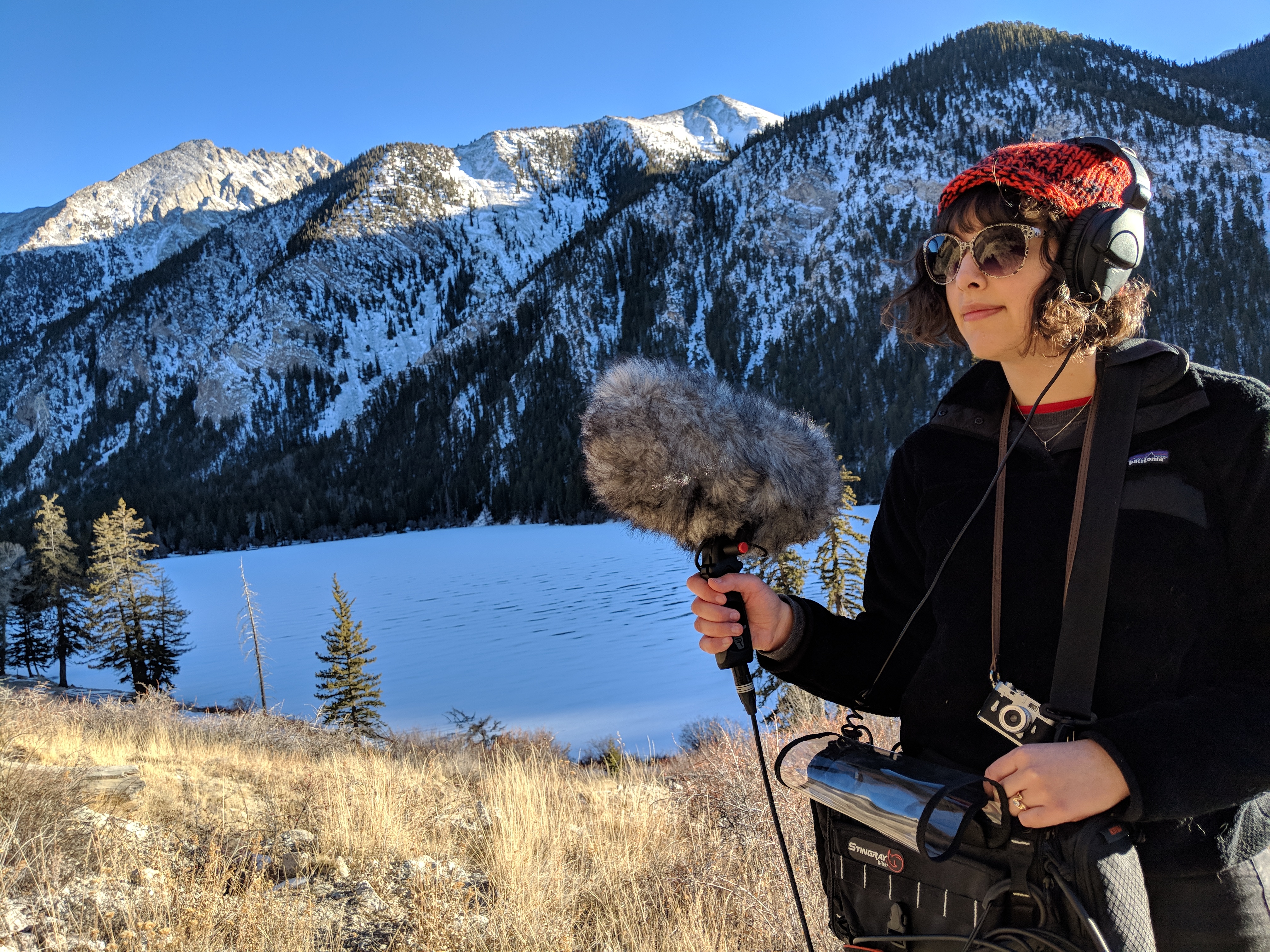
Marinna stands above a frozen lake holding sound recording equipment.
“Right now, the research is very much in the relationship-building phase,” she said. “That’s a big part of what ethical, community-based research looks like—doing your homework, understanding the history, and being present.”
Marinna's interdisciplinary background, including a Master of Fine Arts in sound design, has shaped how she thinks about research and knowledge production. She’s interested in questions of epistemology and how different forms of knowledge are valued in natural resource management. In particular, she hopes to further explore expansive and inclusive knowledges and ways of knowing, including Indigenous ways of knowing, and how they can inform fisheries science and policy without being treated as secondary to Western scientific frameworks.
During the summer of 2025, Marinna attended the Inclusive Impact Conference at MSU which reinforced for her the importance of care in community-based research. “It got me to thinking about the ways you can move from the ideation phase of research to actually working with people on something that matters to them.”
Through the WaterCube NRT Fellowship Program, Marinna has found a scholarly community that reflects her interests in using multidisciplinary research to solve “wicked” water problems. She is especially drawn to the program’s emphasis on integrating social science, policy, and environmental data. “Water systems are inherently social and ecological,” she said. “You can’t separate the human and environmental aspects.”