
Angelique Willis is a dual PhD student in Geography and Environmental Science and Policy. She joined the WaterCube NRT Fellowship Program in 2025 to gain interdisciplinary training in water science, environmental science, big data, and public health.
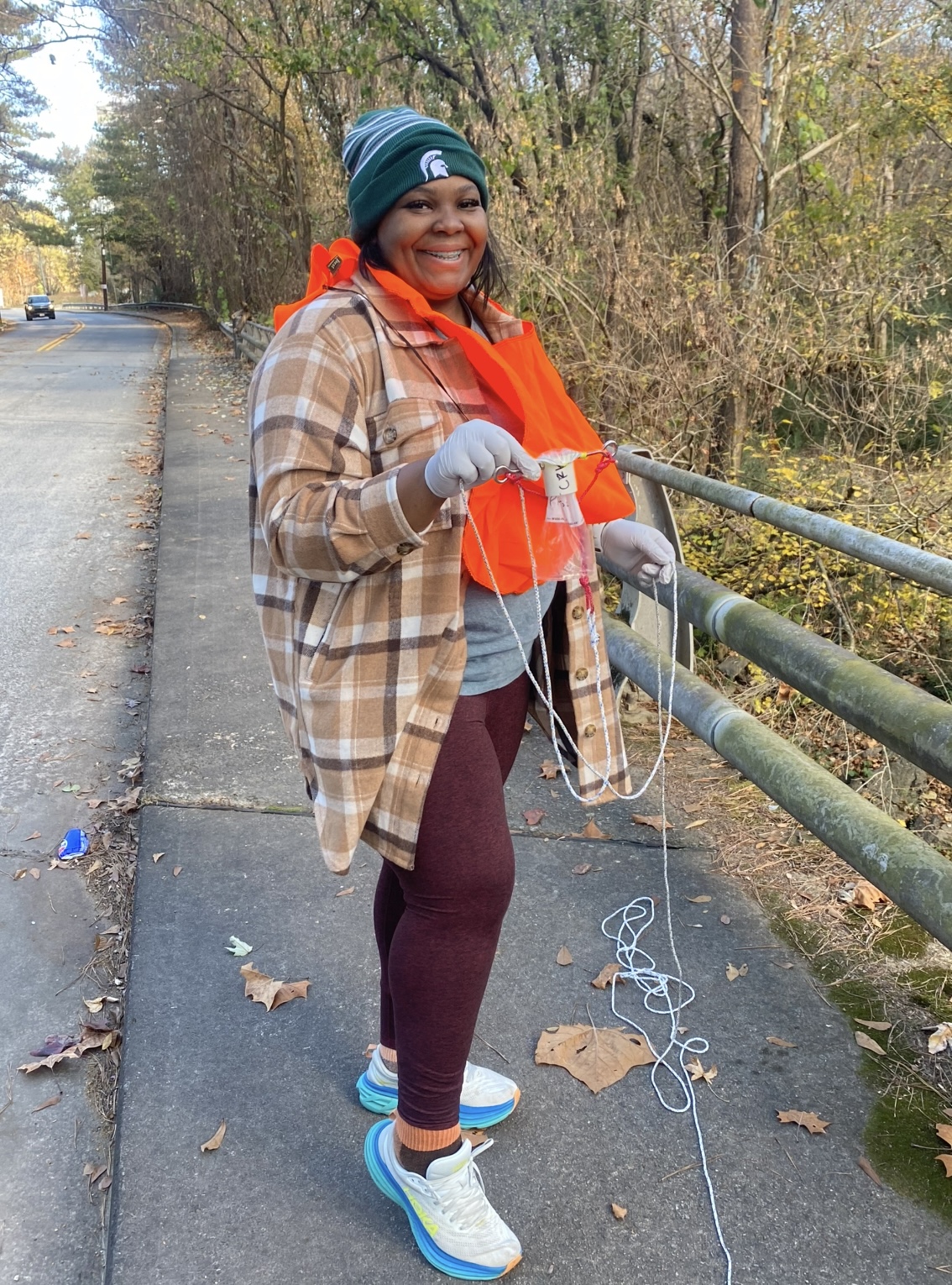
Angelique stands along a roadside path holding sampling equipment.
Angelique's research centers drinking water quality and public health outcomes, with a specific focus on environmental justice and underserved communities. Before coming to MSU, her work examined chemical contaminants (uranium, nitrate, radon, lead, and arsenic) in well water throughout Georgia. These studies assessed disparities in water quality among different racial, ethnic, and low-income populations. Today, Angelique applies similar methods in Michigan, working with community-based organizations in Detroit to address drinking water contamination linked to chemical facilities. Her research investigates how contaminants like chromium-6 in tap water may correlate with local health outcomes, including kidney disease.
“In Detroit, one of their biggest concerns was high rates of kidney disease…and they weren’t sure where it was coming from,” Angelique said. “I know kidney disease is associated with one of the chemical contaminants I work with, which is chromium-6.”
Angelique found that a local chemical facility was releasing chromium-6 into the groundwater that supplied the community’s drinking water. She is now conducting exposure assessments and epidemiological studies to investigate whether these elevated chromium-6 levels are linked to the community’s kidney disease rates.
During the summer of 2025, Angelique contributed to community projects, policy initiatives, and collaborative research to improve drinking water quality. As a Yale Environmental Fellow, she partnered with the nonprofit Freshwater Future to address drinking water affordability and quality in Michigan. She helped update Michigan’s State Revolving Fund criteria so high-poverty communities qualify for infrastructure funding. In Benton Harbor, Angelique worked directly with residents, distributing water filters and collecting local water quality data. She also published findings on well water quality in Georgia and is preparing manuscripts on public health outcomes and emerging contaminants in U.S. drinking water systems.
Angelique's summer experiences reflect the kind of interdisciplinary thinking she values in the WaterCube NRT program.
“We’re trying to have collective ingenuity where we’re no longer approaching problems as our individual disciplines,” she said. “We’re not relying on titles or labels. We’re trying to find creative ways as a collective unit to solve these problems. And that’s what I love about WaterCube NRT.”