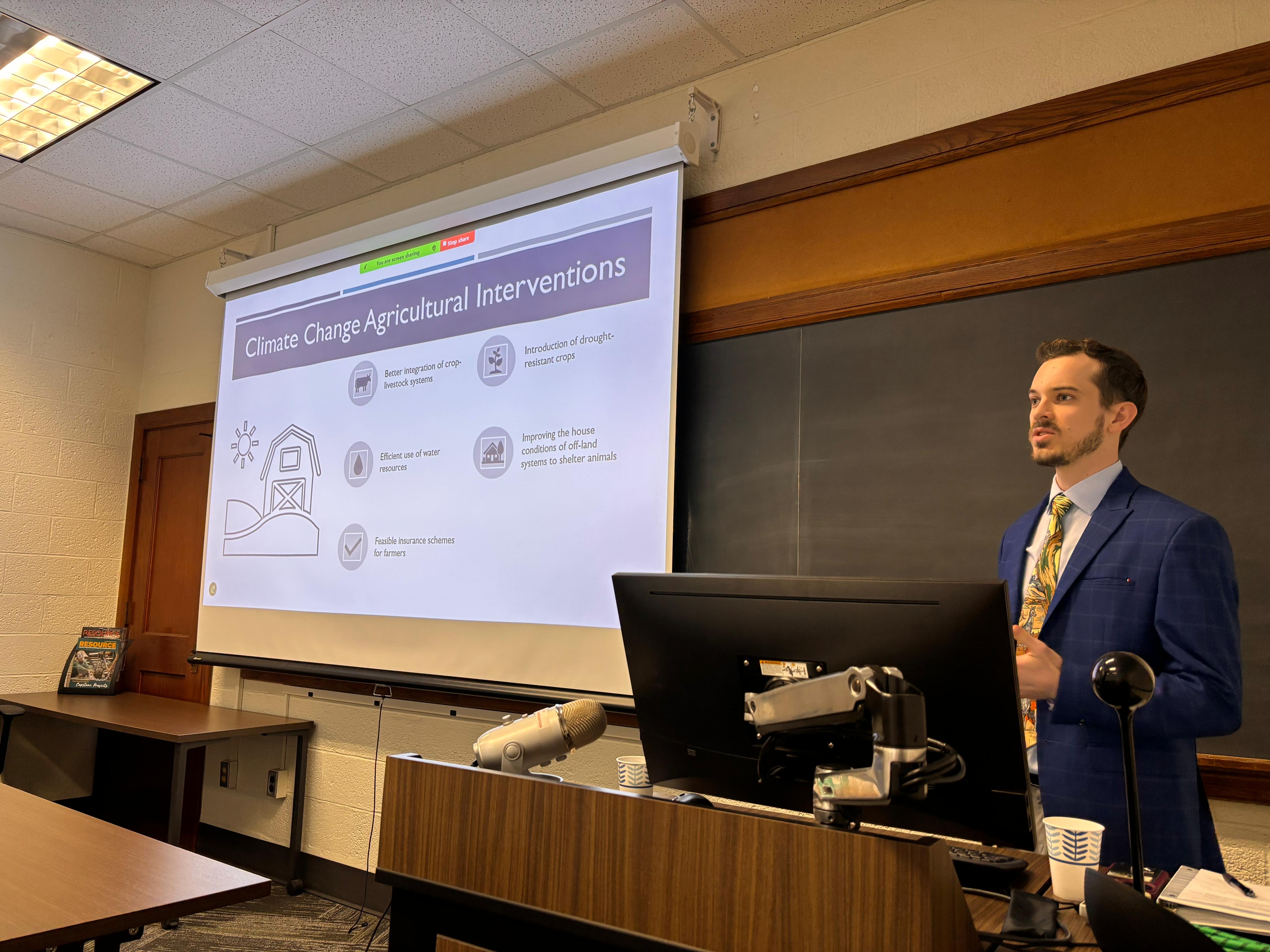
Kieron presenting his research on climate change agricultural interventions.
Kieron Moller received his PhD in December 2025 from the Department of Biosystems & Agricultural Engineering. He joined the WaterCube NRT Fellowship Program in 2024 to expand his collaborative research experience and gain an interdisciplinary perspective on water and agricultural systems.
Kieron’s research focuses on improving agricultural resilience in low- and middle-income countries, using Senegal as a case study. “During my time with the WaterCube, I’ve exclusively looked at Senegal. They have diverse agricultural production and a diverse climate—the Sahara Desert is north of the country, and then there’s a tropical, forest area in the south.” He’s developing a methodology to quantify resilience, evaluating how changes in farming practices, like planting density and fertilizer application, affect farmers’ ability to recover from floods, droughts, and other climate-related stressors.
While Kieron has not yet visited Senegal, he collaborates with local contacts, including familial connections to Senegalese officials and NGOs. “It’s kind of this quirk of chance that this connection ended up working out this well,” he said. Using government reports and research studies, Kieron compares farmers’ income and food production before and after a major climate event to identify which agricultural strategies are most resilient.
During the summer of 2025, Kieron presented his research at the American Society of Agricultural and Biological Engineers (ASABE) Annual International Meeting in Toronto, Ontario. The conference gave him the chance to share his work with other researchers and see how his approach to studying agricultural resilience fits within a broader context.
During his time in the WaterCube NRT program, Kieron has continued to engage with the wider water community at MSU, attending meet-and-greets and brown-bag seminars. He appreciates these lower-pressure situations, which make it easier to talk to faculty, ask questions, and have meaningful conversations about research and life with a community of like-minded scholars.