
Leo Baldiga is a PhD student in the Department of Geography, Environment, and Spatial Sciences. He joined the WaterCube NRT Fellowship Program in 2024 after encouragement from his advisor, Professor Sandra Marquart-Pyatt, who was involved in the program’s original grant proposal. Leo's research bridges social science, water management, and emerging agricultural technologies, with a focus on Southeast Asia.
In Thailand, Leo studies the digitalization of agriculture and the rapid adoption of drones. He is exploring how these changes influence major livelihood and water management decisions for smallholder farmers, as well as the sustainability of smallholder agriculture in the long term.
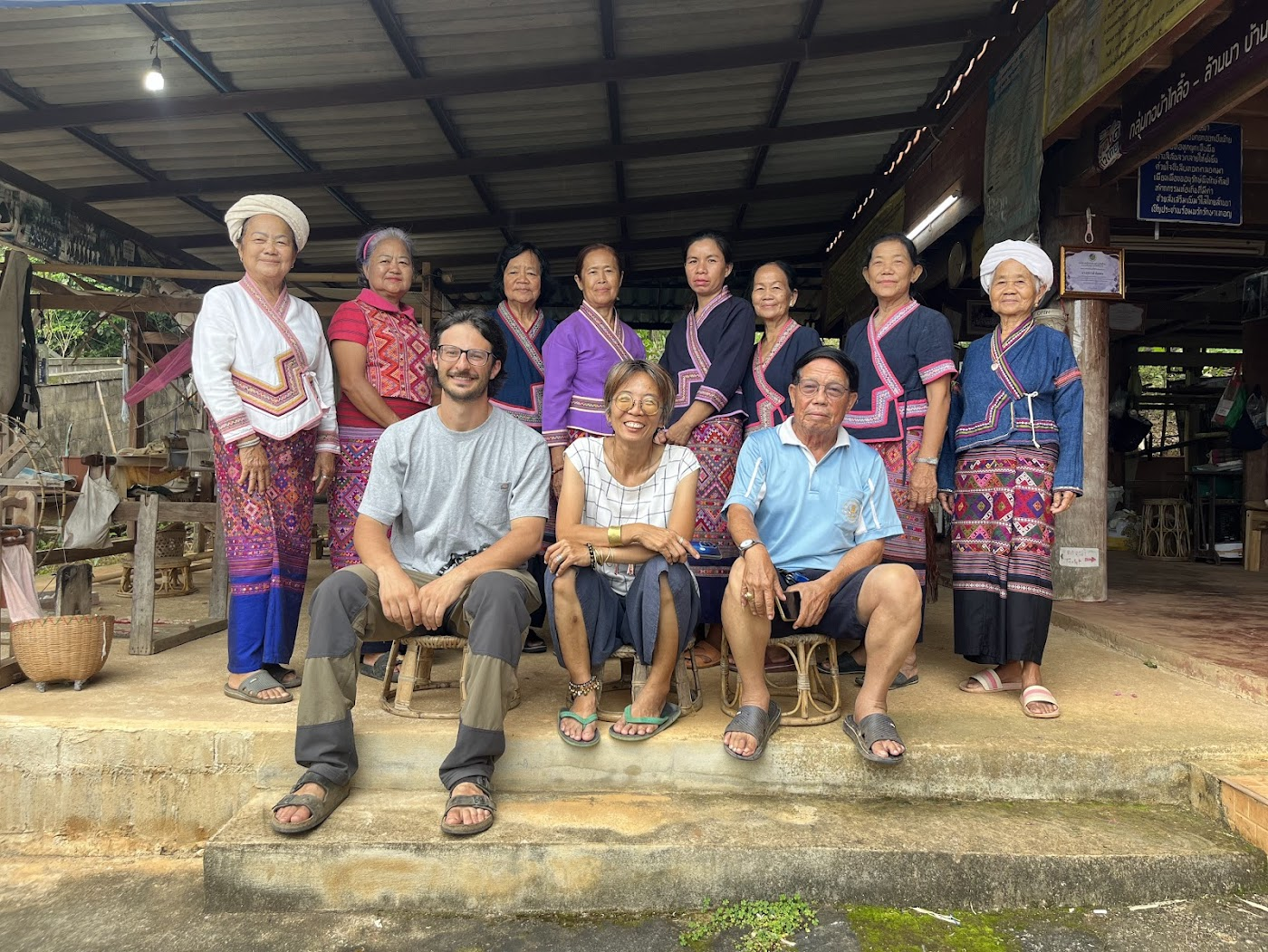
Leo alongside local community members in Southeast Asia.
“There’s a lot happening with public-private partnerships, subsidies, that is changing how drone companies, the government, and farmers interact. It’s unlike anything that we’ve seen before in agricultural mechanization,” he said. Leo has observed that some farmers now manage their entire operation through a single tool, their cell phone, coordinating service providers to plant, plow, spray, and fertilize their fields, all while navigating a landscape where canals and local governance determine how water is allocated for irrigation.
More recently, Leo has expanded his work into Cambodia, where he’s part of a collaborative project with Dr. Soksamphoas Im (Michigan State University) and Assistant Professor Kaley Clements (Duke Kunshan University) examining a planned canal connecting the Mekong River to the sea.
“I was there [Cambodia] this summer and last summer doing preliminary field scouting,” he said. “Kaley is a documentarian, so we’re working on a film for the project, and there will be writing outputs as well.”
Reflected in his approach to research, Leo values the collaborative aspects of the WaterCube NRT. He cited that the annual WaterCube Retreat and Symposium, brown-bag seminars, and conferences like Fate of the Earth have allowed him to connect with peers and advisors from a range of departments and interact with people who are working on water throughout the university.
Leo's ongoing work in Southeast Asia, combined with his program experiences, positions him to continue advancing interdisciplinary research at the intersection of water, agriculture, and technology, while contributing to broader conversations about sustainable water management in the region.