
Published February 24, 2026
The 2026 WaterCube NRT Annual Retreat and Symposium, held Feb. 20 at the Kellogg Hotel and Conference Center, featured 11 trainee research presentations followed by a panel on Careers in Water. Moderated by third-year PhD student and WaterCube NRT trainee Jay Revolinsky, the conversation involved four distinguished professionals from different corners of the water world. Graduate students and early-career professionals heard from Elliot Smith, Tammy Newcomb, Joan Rose, and Grant Brooks about the many ways that passion and persistence can shape meaningful careers in this essential field.
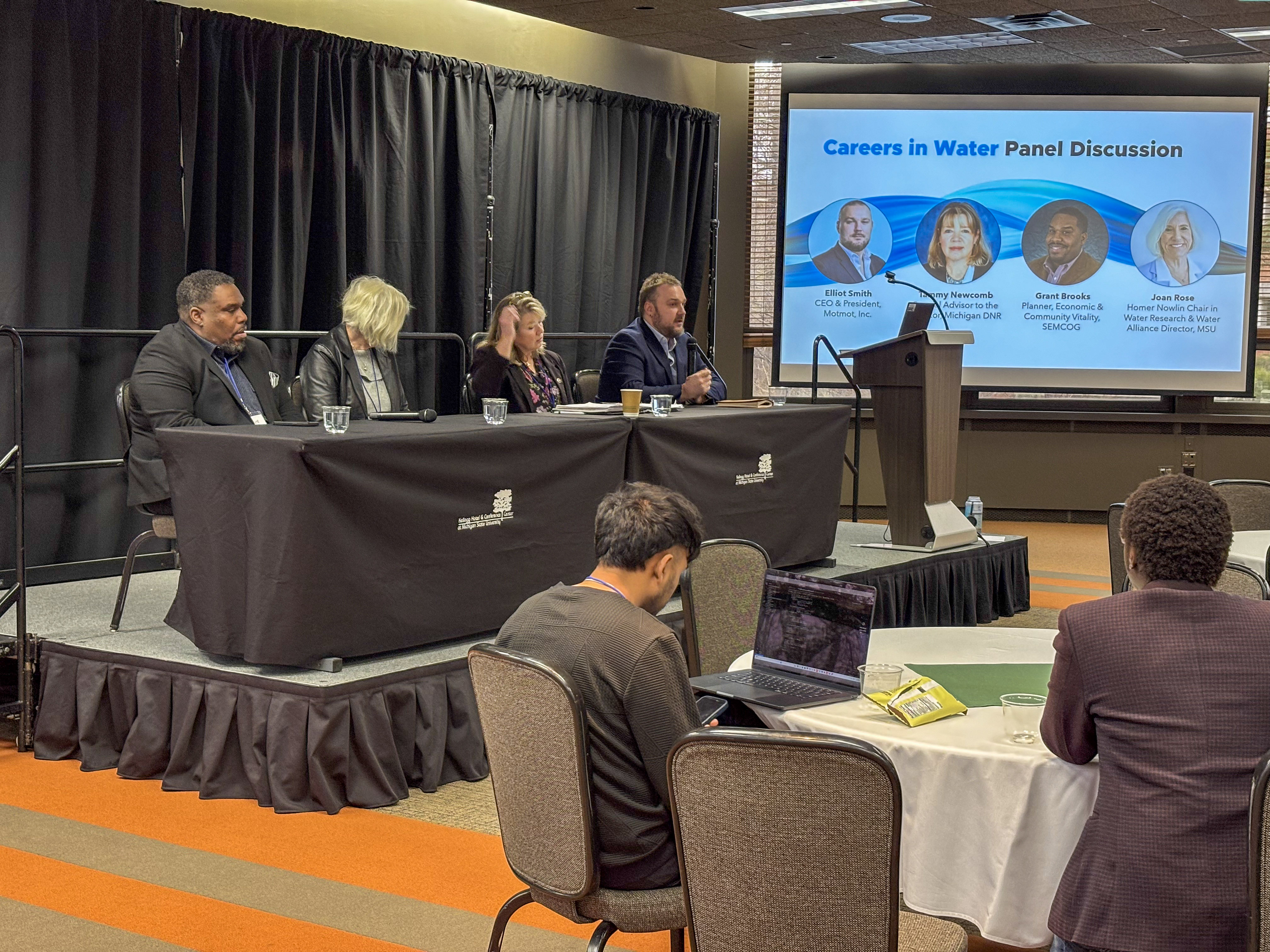
Panel on Careers in Water featuring Grant Brooks, Joan Rose, Tammy Newcomb, and Elliot Smith.
Elliot Smith, co-founder and CEO of Motmot Inc., kicked off the panel by explaining how years of municipal consulting in Southeast Michigan revealed for him the difficulty of managing “the lifelines beneath our feet,” or underground water mains. This led Smith, a civil engineer, to found Motmot in 2024. The Detroit-based company addresses aging drinking water infrastructure, using autonomous underwater robots to inspect pressurized pipes and build better risk assessment profiles.
Shifting from local to statewide resource management, Tammy Newcomb, Senior Water Policy Advisor for the Michigan Department of Natural Resources (MDNR), described herself as a “compulsive pragmatist," taking advantage of every opportunity and striving to do things that matter. She explained how her career zigzagged from studying smallmouth bass habitat, through a PhD, a faculty position at Virginia Tech, and eventually into leadership roles at the DNR. Newcomb now leads statewide efforts to prevent invasive carp from entering the Great Lakes.
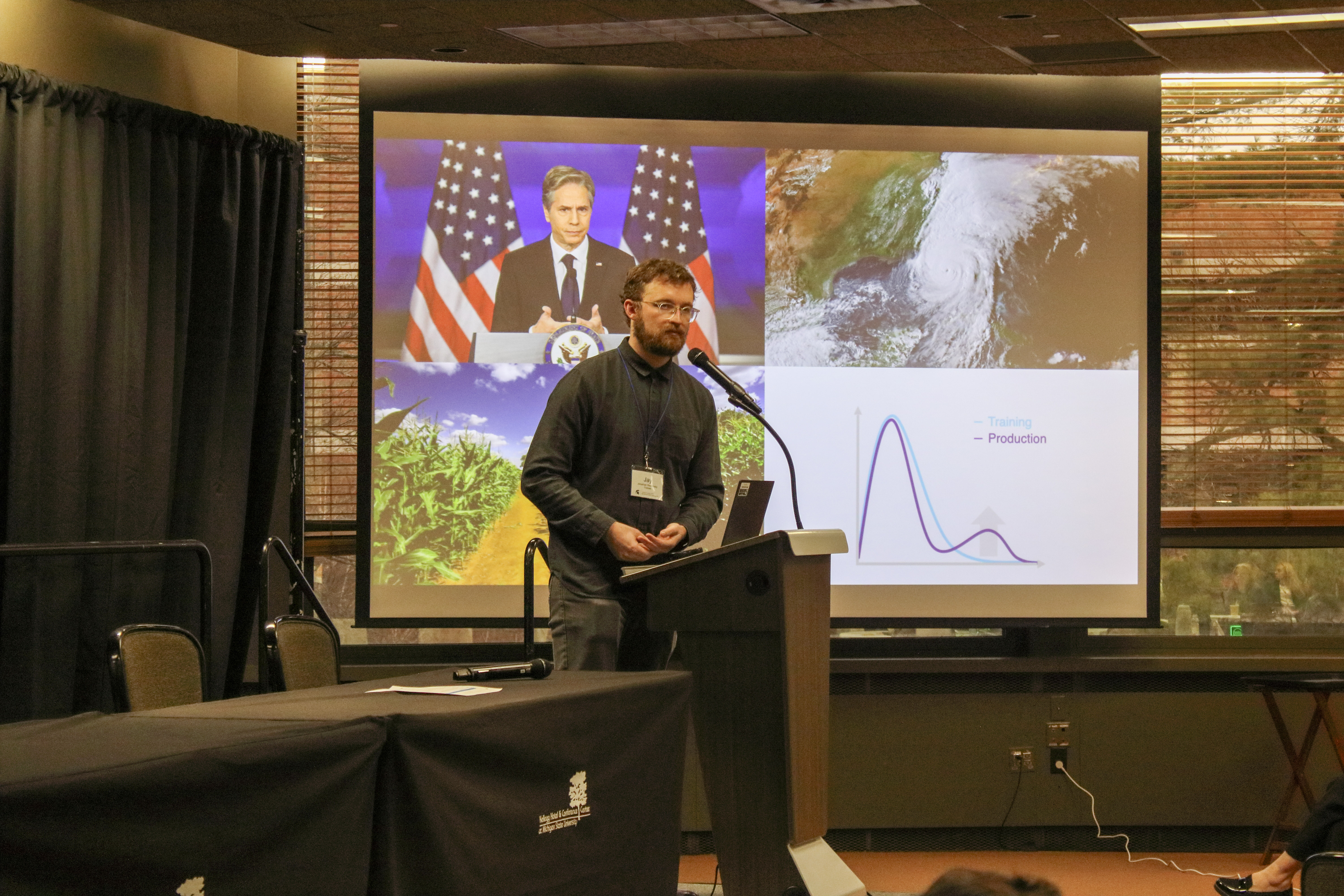
Jay Revolinsky, a PhD student in the Department of Computer Science and Engineering, presents research on building flexible data models.
Also working at the intersection of state policy and environmental health is Joan Rose, Homer Nowlin Chair in Water Research at MSU and director of the MSU Water Alliance. Rose traced her own fascination with water back to the microscope, stating, “I looked under the microscope and said, ‘whoa this is a cool world.’ And I wanted to be a microbiologist.” In the decades since, her work has spanned academia, utilities, and government partnerships, including Michigan’s beach water monitoring and wastewater surveillance programs. Rose urged the WaterCube NRT trainees to embrace multidisciplinary training, find mentors across fields, and view career detours as valuable additions to their journey.
Grant Brooks, a planner with the Southeast Michigan Council of Governments (SEMCOG), serves as a prime example of this career detour, offering an alternative perspective as someone who did not start out with a career in water. The former teacher explained that four years ago he was given a project to get people more interested in water, specifically water treatment. “Everyone loves to go home and turn on the water, but many people don’t realize there’s a process in all of that; someone whose job it is to get clean water to your homes. Collaborations with the Great Lakes Water Authority and other organizations in Southeast Michigan have resulted in greater K-12 outreach which Brooks hopes will spark something earlier on that draws more people into these careers.
Despite their varying backgrounds, each panelist tells a similar story: careers in water don’t always follow a planned or linear path. Instead, they’re driven by a passion for community, the motivation to protect public health, and environmental stewardship.
The session ended with a reminder that solving today’s complex water challenges will require creative, collaborative minds. Programs like the WaterCube NRT are supporting this effort by breaking down disciplinary silos and bridging academia, government, industry, and community.
Story by Aja Witt