
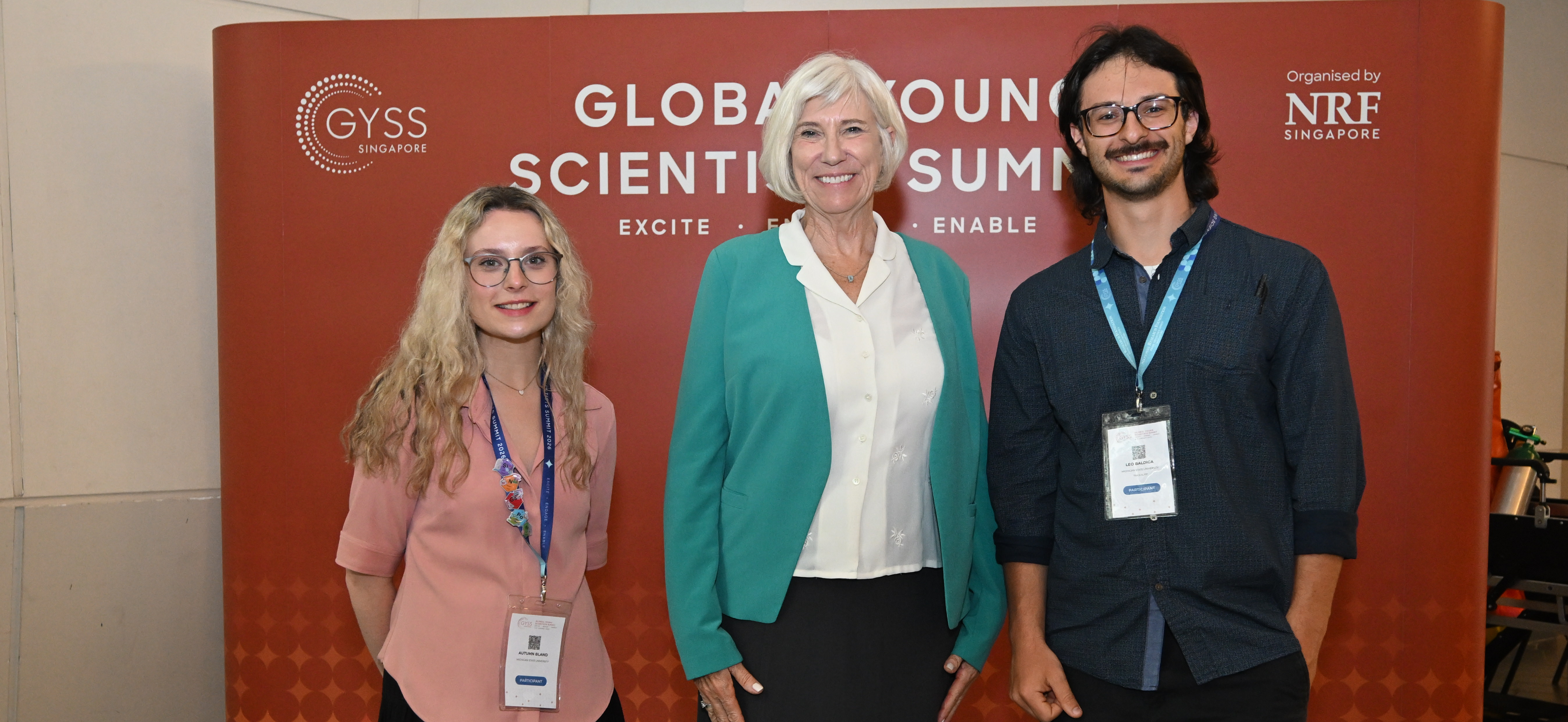
Autumn Bland, MSU Water Alliance Director Joan Rose, and Leo Baldiga at GYSS in Singapore, Jan 5-9, 2026. PHOTO Credit Samantha Yeap, GYSS Photo Gallery
Published January 29, 2026
Autumn Bland and Leo Baldiga, both members of the WaterCube NRT Fellowship program, represented MSU and the MSU Water Alliance at the 14th edition of the Global Youth Science Summit (GYSS) in Singapore, held Jan. 5–9. The event convened young researchers from around the globe to engage with leading scientists, and explore how science can better serve society. For both fellows, the summit reinforced WaterCube NRT’s core values of multidisciplinary collaboration and diverse scientific perspectives.
As one of the few social scientists present, Baldiga presented a poster on the global diffusion of agricultural drones. The poster session sparked engaging conversations with engineers, technologists, and natural scientists about advancing sustainable and equitable food systems while also addressing the social and environmental tradeoffs of AI and robotics.
“It was heartening to see how interested many participants were in the social and environmental implications of technological advancements in agriculture,” Baldiga said. “And to learn about new technologies other attendees were developing in their work.” These conversations emphasized the need to integrate social insights into technological development, particularly in water- and agriculture-related fields. Baldiga plans to maintain connections with GYSS participants, hoping these exchanges lead to future cross-disciplinary collaborations.
For Bland, the experience blended personal meaning and professional inspiration. One highlight was connecting with optical physicist Donna Strickland (University of Waterloo) and microbiologist Joan Rose (Michigan State University) who participated in the panel “Breaking Barriers, Leading Change: Challenges in STEM.”
Bland described the session as “an extremely inspiring and realistic roadmap” for the future of women in STEM. Seeing women who embody global impact and leadership, and hearing their honest reflections, was deeply motivating, she said.
Interactions with young scientists from varied cultural, disciplinary, and geographic backgrounds also reshaped her perspective. “As a graduate student, these exchanges always bring a sense of comfort in the uncertainty, knowing that the work we’re doing does matter,” Bland said. “It reminds me that while our methods and fields may differ, our drive to solve wicked scientific problems is a shared language.” Peer feedback bolstered Bland’s confidence and underscored the value of convergence research.
Both fellows noted how GYSS will shape their ongoing work in the WaterCube NRT program. For Bland, the summit reaffirmed that community trust, effective communication, and knowledge mobilization are essential for achieving societal impact. “Knowledge mobilization cannot be an afterthought,” she explained. “It must be a core component in how of how we move research forward.” She intends to prioritize collaboration and convergence throughout her training.
Together, Bland and Baldiga’s experiences at GYSS illustrate the power of WaterCube’s interdisciplinary approach to water-related challenges. By encouraging global engagement and cross-disciplinary dialogue, WaterCube NRT fellows are contributing to a future where science is innovative, inclusive, reflective, and responsive.
Story by Aja Witt