Published April 10, 2026
Dozens of community members gathered at UrbanBeat in Old Town, Lansing, on Sunday, March 29, to celebrate the permanent installation of six winning poems at Ingham County’s Tollgate Drain Wetlands. The event marked the culmination of the “We Are Water” poetry contest, created by Lansing Poet Laureate Emerita, and Michigan State University alumna, Ruelaine Stokes.
Stokes launched the “We Are Water” poetry contest in August 2025, encouraging residents of Ingham, Clinton, and Eaton counties to submit poems exploring their relationship to water, with winning entries to be featured on lectern signs at the wetlands.
The response was overwhelming. 241 submissions flooded in, representing individuals from all walks of life, including three winning submissions by MSU graduate and undergraduate students.
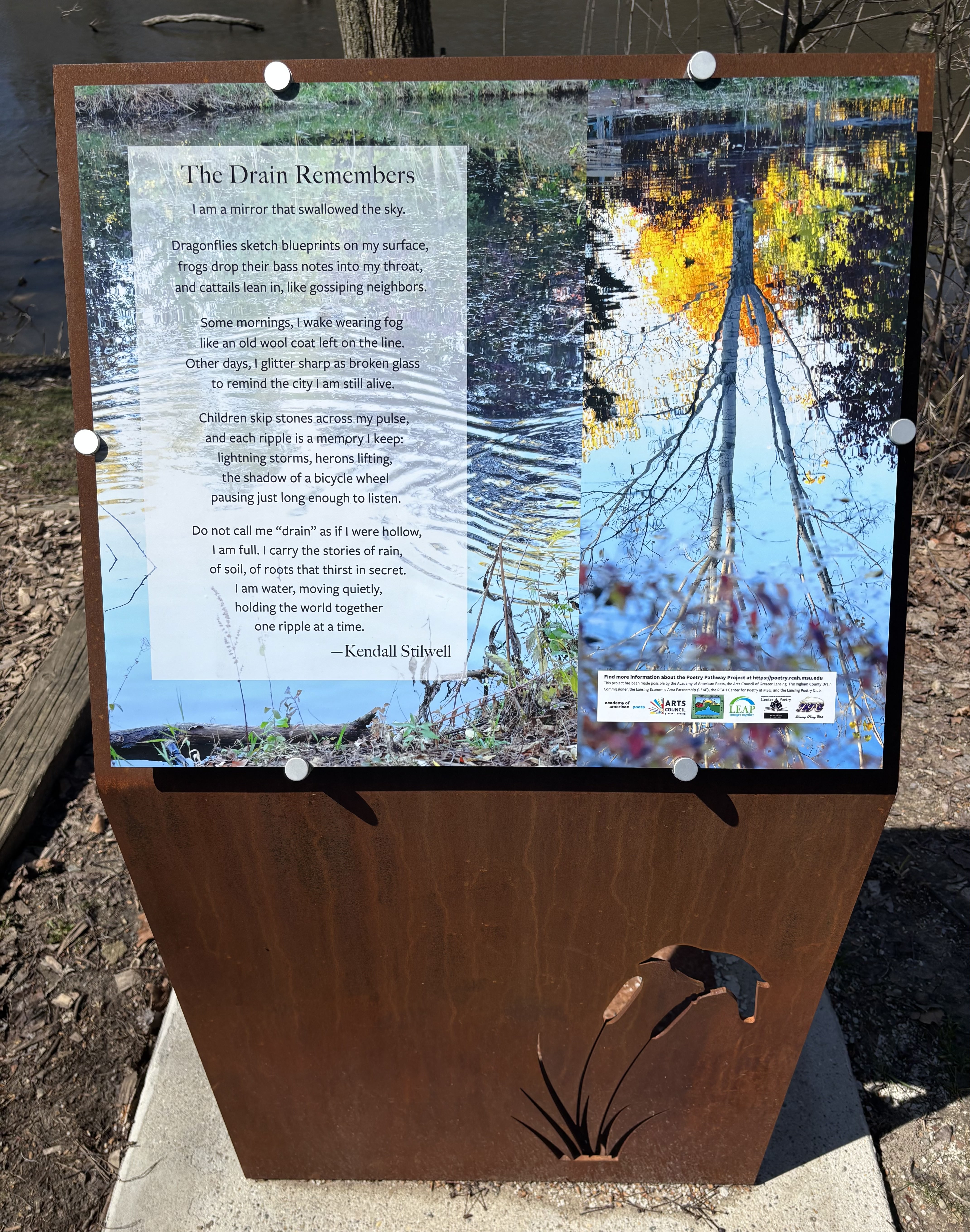
Kendall Stilwell is an undergraduate student in the Department of Animal Science.
“The winning poems were so rich in precise, vivid details,” Stokes recalled, reflecting on which poems stood out for her most. “They [the poets] really were nature lovers. They could see the animals, they could see the plants growing, and they were able to capture that in words…Tollgate really came to life in their poems.”
Kendall Stilwell, an undergraduate student interested in veterinary medicine, personified the drain itself in her poem “The Drain Remembers”. Through this perspective, she shows readers how the drain sustains life, how it holds the city’s memories, and how it reflects both the natural and human activity around it.
“I’m kind of just hoping people who see my poem don’t overlook it,” Stilwell said. “That they embrace it [Tollgate] for what it truly is and what it does for the environment and the water system.”
Stilwell’s poem is a gentle reminder of the important role Tollgate plays in protecting the city’s water system. It captures stormwater runoff and uses natural wetland processes to remove pollutants, improving water quality before it continues through the watershed.
“The first line I adore,” Stokes said of Stilwell’s poem. “‘I am a mirror that swallowed the sky…’ She captures the way in which water becomes mirror-like and reflects everything around it. It’s a beautiful poem.”
Jasmine C. Snow, a master’s student in journalism whose research focuses on media messaging, representation, and community reporting, was motivated to submit her poem “Ducks” by a desire to reconnect with nature after time spent indoors.
“Some of my friends and loved ones are really into environmental justice, but I’ve been stuck inside for so long with my job and what I do [as a student],” Snow said. “I wanted to reconnect with that and think more deeply about what has been important to me in the last couple of years.”
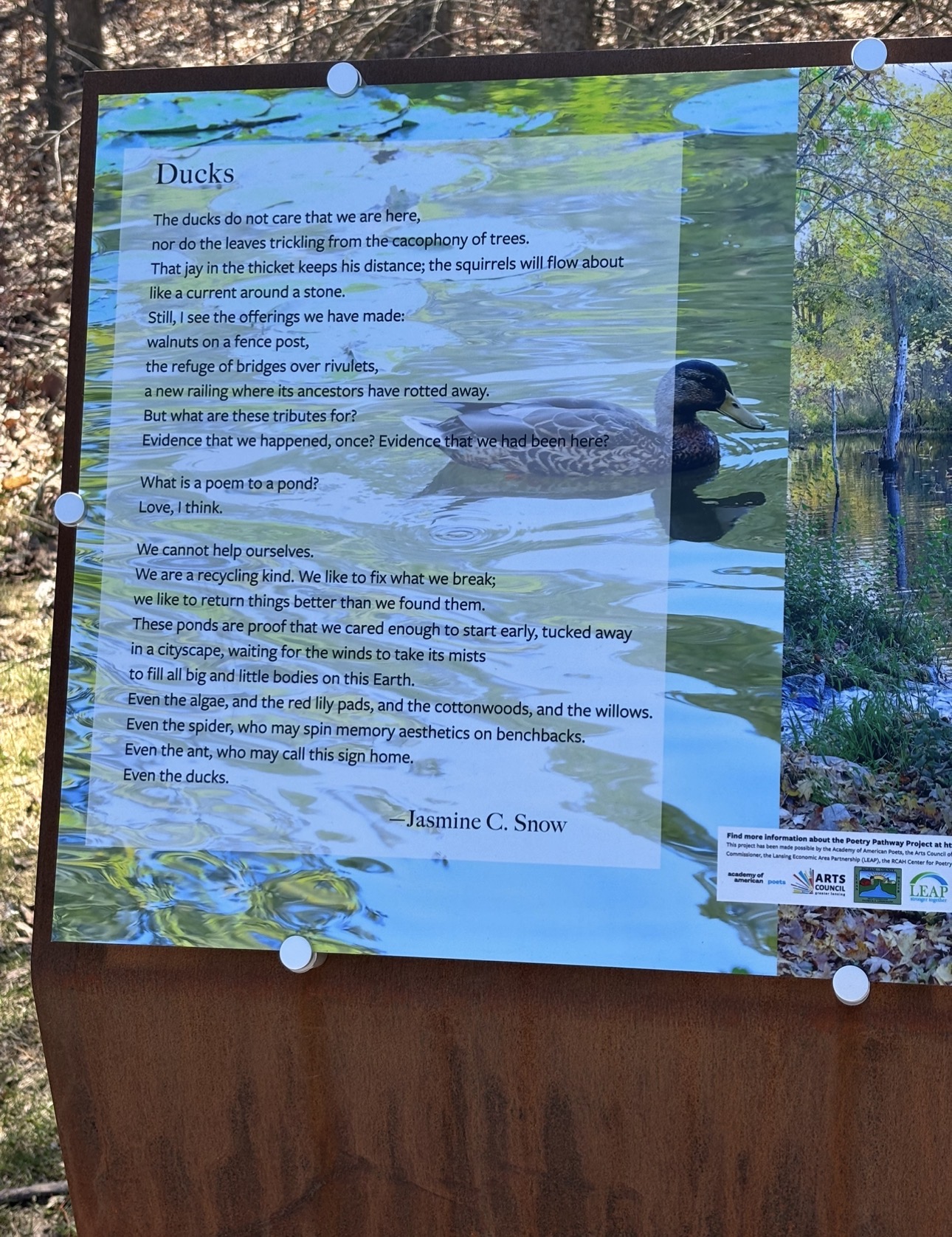
Jasmine Snow is a graduate student in the School of Journalism.
Snow’s poem details the coexistence of humans and wildlife at Tollgate. Human presence and the things we leave behind in nature are juxtaposed against the indifference of the natural world. Walnuts on a fence post, repaired bridges, or new railings represent little acts of care. Snow describes these things as ways of leaving evidence that humans were present, and that we’ve tried to fix the things we’ve broken.
“One of the things I really like about this poem are the lines that ask ‘What is a poem to a pond? Love, I think,’” Stokes said. “I think all of the poems here at Tollgate are love poems to this beautiful nature preserve; this beautiful drain that purifies the water using natural means.”
Other winning poems include “This Is Not a Park” by Dana Hardy, an MSU music education student, “Alone, but together, at Tollgate” by Melodie Wright, “I’ve Begun to Run Out of Ideas, Good or Bad” by Tim Lane, and “Reflection” by Daisy Roberts.
Each poem now lives on a durable lectern sign, accompanied by photography from Kim Kauffman. These installations invite visitors to experience the wetland as a place for reflection and deeper connection.
“The idea was to make poetry visible,” Stokes said. “Each poetry sign is also a sign of Welcome to each visitor to the park. It’s a human voice that adds meaning, adds images, adds warmth to the environment…Science is such a powerful language and can describe how things work in such precise details. Poetry provides a human experience for it.”
Story by Aja Witt