
Michigan Sea Grant brings Great Lakes education to the St. Clair Shores Adaptive Playground Program
Published August 31, 2026
Michigan is a state defined by its waters. Surrounded by four of the five Great Lakes, it sits at the center of the largest surface freshwater system on Earth. These lakes hold roughly 20 percent of the world’s surface freshwater, and 90 percent of the U.S. supply, shaping the state’s economic, ecological, and recreational identity.
Fishing, swimming, and boating are a common part of growing up in the Great Lakes state, where the majority of residents visit the beach at least once during the year. But accessing these outdoor activities can present unique obstacles for children or adults with disabilities.
Through a recent partnership with Michigan Sea Grant (MISG)—a cooperative program between Michigan State University (including MSU Extension) and the University of Michigan—the St. Clair Shores Adaptive Playground Program (APP) is working to address this and provide Great Lakes education to its campers.
Camp Director Cassidy Jacobs explained that the 10-week program for children and young adults (ages 5 to 26) with physical and cognitive disabilities “provides opportunities to take a break from school and therapies and focus on having a fun and safe summer in an inclusive environment.”
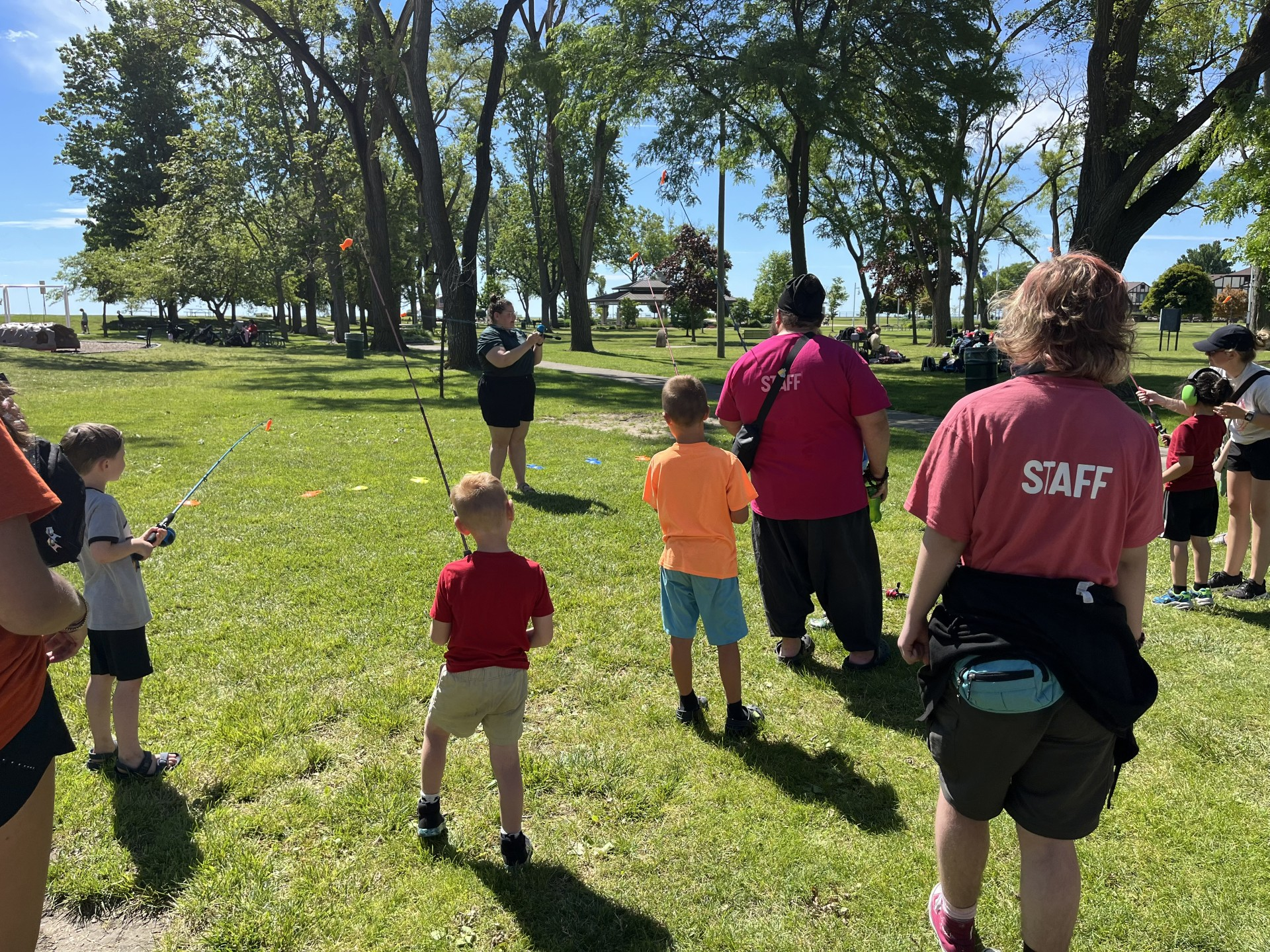
Angela Scapini leads a session on casting with young campers.
Campers spend their summer at a local park overlooking Lake St. Clair—often referred to as the “Heart of the Great Lakes”.
“Our camp is filled on a sign-up basis, where parents have the option to send their children week by week, or for the entire summer,” Jacobs said. “We get campers from all over the Metro Detroit area that come back year after year.”
The decision to introduce specialized Great Lakes education addresses a distinct need within the group’s adaptive summer programming.
“We saw a need for Great Lakes education within the subset of campers we service,” said Paige Zuccaro, assistant director of the APP. “We strive to make our program a fun summer break from the demands of school, while still including educational and socio emotional components, so we’re incredibly grateful to have Angela teaching our campers about the Great Lakes.”
Since 2025, the Adaptive Playground Program has partnered with Angela Scapini, a Michigan Sea Grant Extension educator. Scapini’s work primarily focuses on K-12 education in the Great Lakes, creating resources for teachers to use in their classrooms or at camps.
Within the APP, students are grouped by age (elementary, middle school, high school, adult) which allows Scapini to adapt her program where necessary.
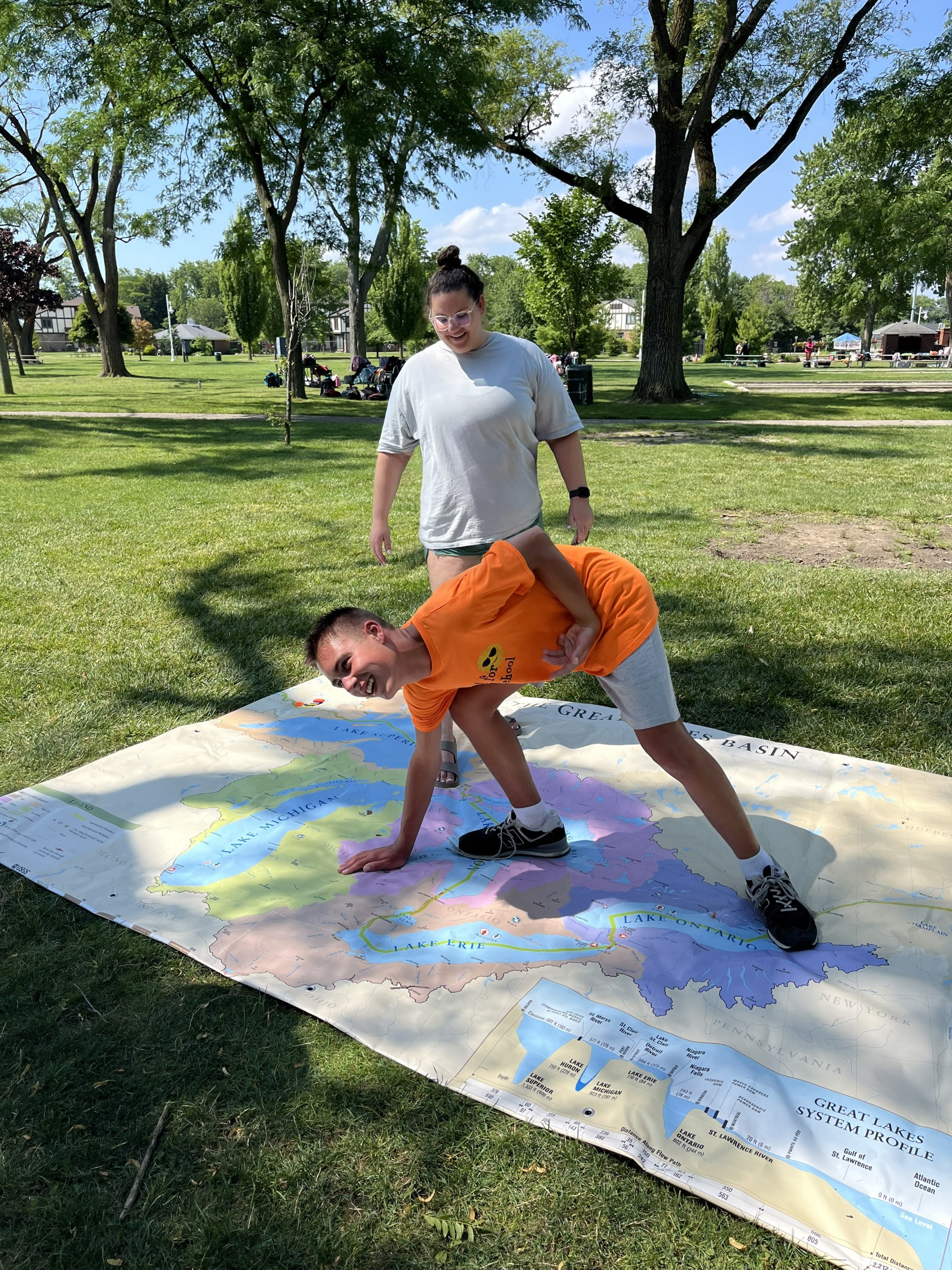
Scapini works with a camper during a hands-on Great Lakes geography lesson.
“For the younger kids, I focus on adding sensory activities [touching the water] and simplifying everything,” Scapini said. “If I’m doing fishing, for example, we’ll work on casting and the technique of getting the cast instead of looking at fishing regulations or guides.”
For the older children and adult campers, Scapini offers more one-on-one attention and time.
“Time is a huge thing,” she said. “The campers need to be able to process things and take it in at their own pace. A lot of this is just being flexible for the students and their needs, and as needs arise, being able to accommodate them.”
A core priority for this collaboration is fostering sustained engagement rather than single-visit outreach. Scapini explained how this involves building a rapport with students and a routine where they know what to expect.
“This year, I’ve been coming to camp every Tuesday so they know when to expect me. They’ll say ‘Oh, Miss Angela’s here for science,’ which is really fun,” she said.
For educators, organizers, or watershed groups looking to make their outdoor learning more accessible, Scapini noted that the process is much less daunting than it seems. The key is listening; acting as a thought partner to understand specific individual or community needs.
“A lot of times it’s just a small tweak, but that tweak can make a big difference,” she said.
The Adaptive Playground Program runs for 10 weeks each summer. To learn more, or view photos from previous sessions, follow the program on Facebook.
Story by Aja Witt