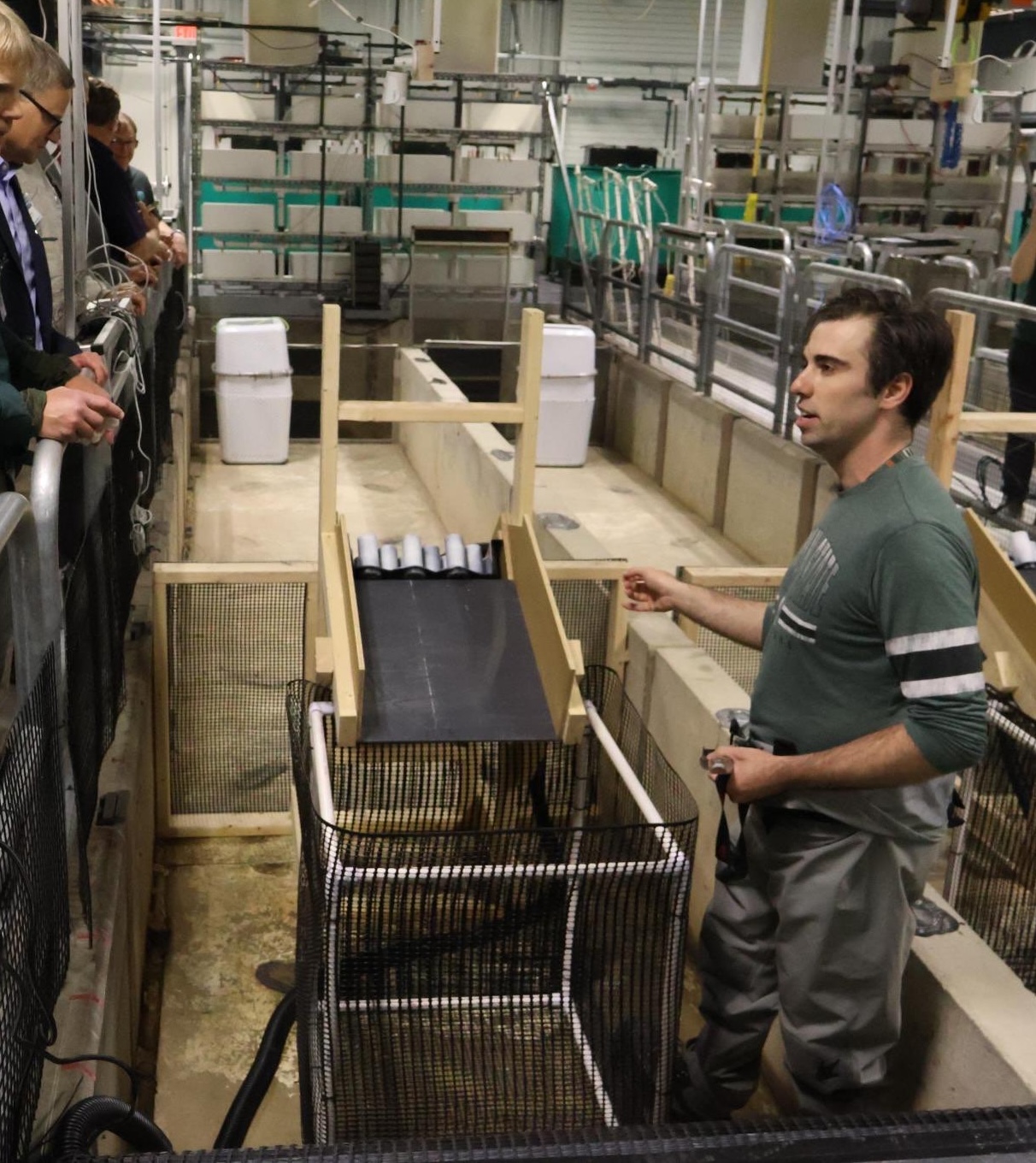
David explains his research during a VIP tour.
David Creamer is a PhD student in the Department of Fisheries and Wildlife. He joined the first cohort of the WaterCube NRT in 2024, following encouragement from his advisor, Associate Professor Michael Wagner, and because the program seemed like a great fit for his work.
Creamer’s research focuses on selective fish passage and the management of aquatic invasive species. “There’s a big emphasis on dam removals, reconnecting the rivers, and restoring the natural balance of things,” he said. “The only problem with this is that in addition to keeping native fish out, a lot of these dams are also keeping out invasive species.” Creamer is working to ensure ecological restorations do not unintentionally benefit invasive species like sea lamprey and allow native fish to access the river.
Most of Creamer’s research is done during the spring and summer at Hammond Bay Biological Station, a USGS facility located on Lake Huron. There, he and his team test ramps and design traps to block sea lamprey from returning to rivers after they go out into lakes and feed. “We’re hyper focused on that stage where they come back to the river to reproduce, so we try to put a device in the river that blocks them from reaching their spawning grounds.” This device forces lamprey away from one area or channel and into another that contains a trap.
Creamer’s research involves collaboration with engineers at the University of Michigan who help measure water turbulence and flow patterns. He also has plans to test these devices in Traverse City with a project called FishPass that addresses the deteriorating Union Street Dam and includes a consortium of state and local governments, tribal governments, and community members.
Through his work, Creamer is contributing to innovative solutions that balance ecological restoration with invasive species management, exemplifying the collaborative, interdisciplinary focus that the WaterCube NRT Fellowship Program promotes.