Published August 27, 2026
As Lansing explores the possibility of hosting the first Bubble Barrier installation in the U.S., researchers from Michigan State University (MSU) and the Grand Valley State University (GVSU) Annis Water Resources Institute (AWRI) are working to ensure the technology succeeds both in the water and with the public.
Led by the MSU Water Alliance, this project is a collaboration between university scientists, corporate partners (Meijer), state agencies (EGLE, MDNR), a local artist, and the city of Lansing.
The full-scale barrier will use a large curtain of bubbles to push plastic and other debris into a catchment system similar to the one used in Amsterdam’s Great Bubble Barrier. A mini model, designed by former GVSU engineering students Erin Jagger and Scott Strayer, has replicated the technology on a smaller scale, allowing community members to visualize how the bubble curtain will operate in the Grand River.
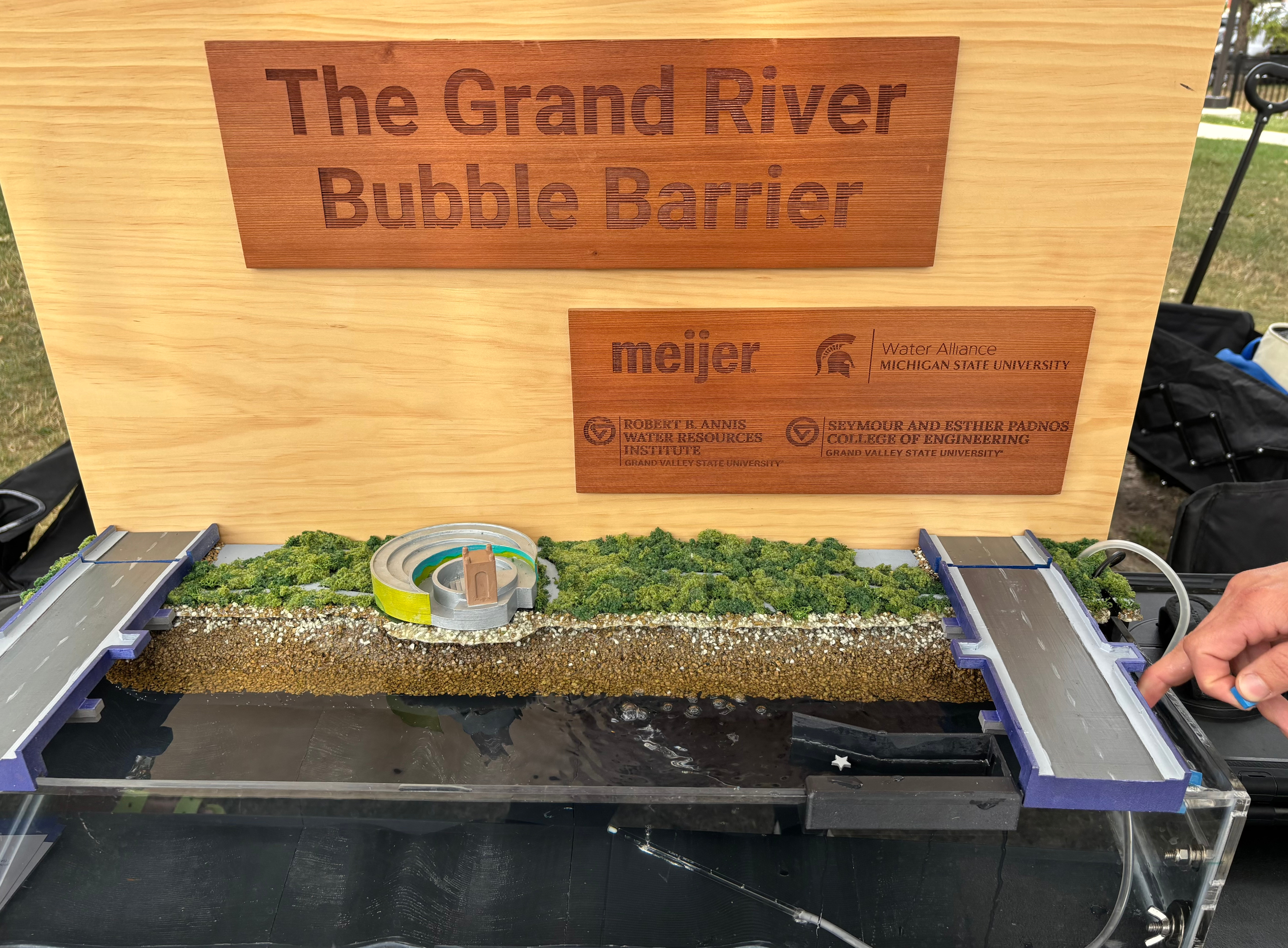
The mini model allows community members to visualize how the bubble curtain technology will operate in the Grand River.
GVSU sociology professor Amanda Buday and her team of student researchers have taken the mini model out to several locations along the Grand River this summer, talking with Michigan residents to better understand their perceptions, questions, and concerns about the bubble barrier.
“A lot of the time, science is happening at the level of the ecosystem without considering how the community is going to react to a new technology,” Buday said. “Being able to see something—to see how it works—can be helpful for people, but also, hearing their questions or concerns can be helpful for us.”
During their field days, Buday and her team have gathered that, while most residents are excited about removing trash from the river, they are equally concerned about the potential impacts on fish and wildlife, whether local taxes will pay for long-term upkeep, and how much difference a single barrier can make in such a long river system.
“For the most part, we’ve had a lot of support for the bubble barrier,” said Emma, one of three student researchers working with Buday. “Most of the concerns would be cost, and then, just how effective it’ll actually be.”
Buday’s role in the project is not to answer these questions, but to identify where gaps in information may exist among the public and bring them back to the broader team. In doing so, she is helping to ensure that community perspectives are part of the research and decision-making process as the project moves forward.
The collaborative nature of this project is something Buday has particularly enjoyed.
“It’s been really rewarding to work on a team where so many disciplines and areas of expertise are represented,” Buday said. “From art to community engagement, the packaging department, engineering, aquatic sciences, and social sciences. It’s great seeing all of the different people connected to this.”
Story by Aja Witt