
Published September 24, 2026
The Aquatic Ecology Hub is exploring opportunities to strengthen connections around coastal resilience in Michigan and the Great Lakes. Hub co-lead Ethan Theuerkauf brings a focus on coastal resilience, while co-lead Elena Litchman has expertise in the area of harmful algal blooms.
Following an August 2026 workshop on coastal resilience, Theuerkauf is thinking through how the hub and the Water Alliance can build on those conversations.
How have you and Elena established a new foundation for the Aquatic Ecology Hub, and how are you using your expertise to guide its development?
For my part, I really want to build off of the coastal resilience work that we’re doing, including the workshop we held in August. I think that’s where I’d like to take this particular part of the hub: building out the Water Alliance’s focus as it relates to coastal resilience in Michigan and the Great Lakes.
We’re still working through the results of that workshop, but I think the major direction is to think more about the human element of coastal resilience and bridge the gap between science and stakeholders.
I think that’s something we’re uniquely positioned to do given MSU’s land-grant mission.
There are elements of infrastructure, protecting coastal habitat and conservation, and a lot of different pieces that need to come together, but I see coastal resilience becoming one of the hallmark issues or topics that we’re exploring.
Are there any major projects on the horizon for the hub?
I would say it’s still in the building phase.
There are funded projects that my lab is doing, including work with the State of Michigan and the National Park Service. What I want to build out through the Water Alliance is some of the broader-reaching elements that those individual projects aren’t going to touch.
I think the Water Alliance can bring resources to bear to be that connector. There needs to be something that’s long-lasting outside of an individual research lab or an individual community.
I’d love to see us build something like a summer research opportunity for undergraduates, or another program through the Water Alliance and its partnerships, focused on that kind of coastal resilience training.
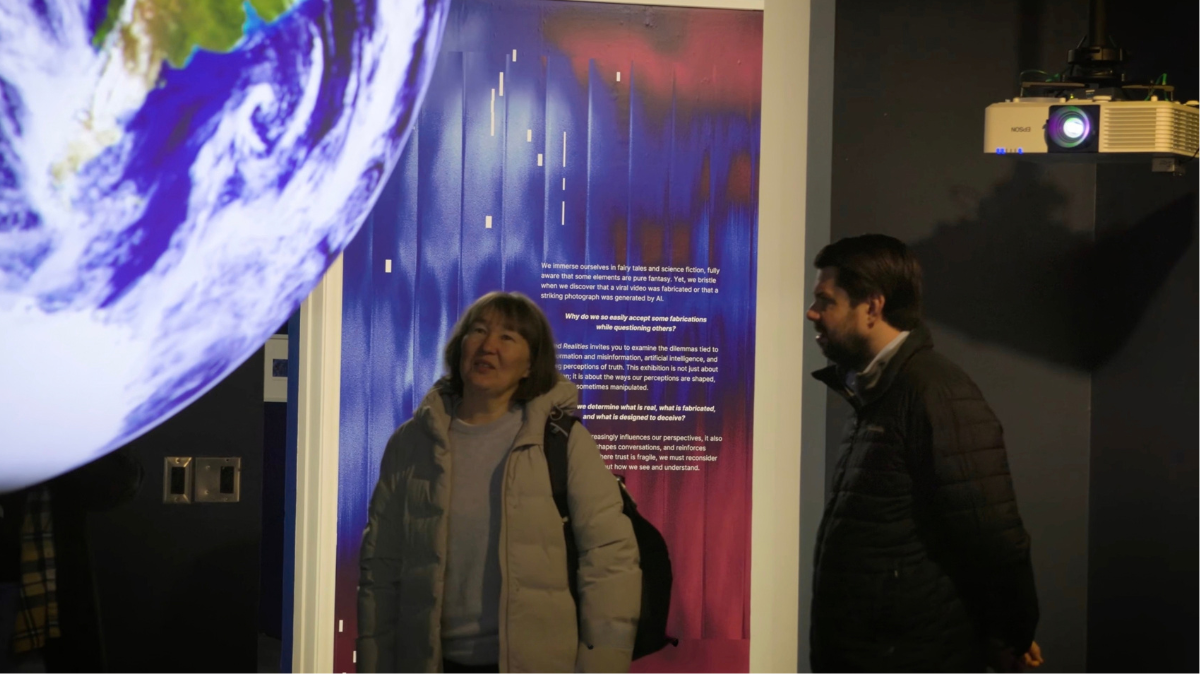
Elena Litchman and Ethan Theuerkauf visit the MSU Museum’s Science on a Sphere exhibit, March 2026.
Are there examples of collaborations across disciplines or sectors with the hub, or collaborations you’d like to explore?
I go back to the workshop in August, which really would not have happened without the help of the Water Alliance. I think that was a good example of what we could do by bringing a focus to conversations around coastal resilience and thinking about the next steps.
There were people from a lot of different disciplines and sectors. I was the only pure coastal geomorphologist there. There were engineers, biologists, and all kinds of stakeholders, and we heard a diversity of thoughts on what resilience means and what it should look like.
I’d like to see more of that. One of the things we’ve been thinking about is what the next step is after having that initial conversation and what role the Water Alliance can play in supporting it.
I think it will involve a diverse range of people. We need many different people at the table, and there are people we didn’t have at that particular workshop. We didn’t have a lot of local folks, so we need more of that.
At MSU specifically, I think there’s probably a need to bring people together under the hub umbrella to think about what our role is in doing this work and how we want to lead it.
What would you like faculty, specialists, and students to know about the hub? Specifically, how can they connect with the hub, and what would they get out of participating with the hub?
One of the challenges with groups like this is getting people engaged among the many things they’re already doing. I think that’s where having some very specialized, topical projects could help.
Coastal resilience is one of those areas, and Elena may have something similar around harmful algal blooms. These are places where there’s a clear need for leadership in the research community.
I’d like to think about having a manageable way for people to engage. Maybe that’s one meeting a semester where we engage with a specific community around a particular topic. Rather than starting with something very large, we can start those conversations and build relationships.
Then, when there is a funding opportunity, we already have those relationships in place.
What do you see the Aquatic Ecology Hub accomplishing during the remainder of 2026?
I think it would be finessing what our role is in this broad, complicated issue of coastal resilience.
What can we fill here at the Water Alliance? Let’s get those players together here at MSU, but also think about who we want to partner with outside of MSU.
Coming into this leadership role with the hub, I wasn’t quite sure where we would go in terms of topics, and I think some of that is exploratory.
But coastal resilience has really bubbled to the top as something important and as a key Water Alliance issue. I think having a focused discussion about where we can go with that and building it out is the main goal.
Interview by Aja Witt