
Jay Revolinsky is a PhD student in the Department of Computer Science and Engineering. He joined the WaterCube NRT Fellowship Program in 2024 and works with MSU Research Foundation Distinguished Professor Jiliang Tang in the Data Science and Engineering Lab.
A big reason Revolinsky joined the WaterCube program was because “so much of computer science research exists within a bubble, or a vacuum,” he said. Too often the research remains in the lab. He wanted a way to branch out beyond the discipline and connect methods to real-world applications.
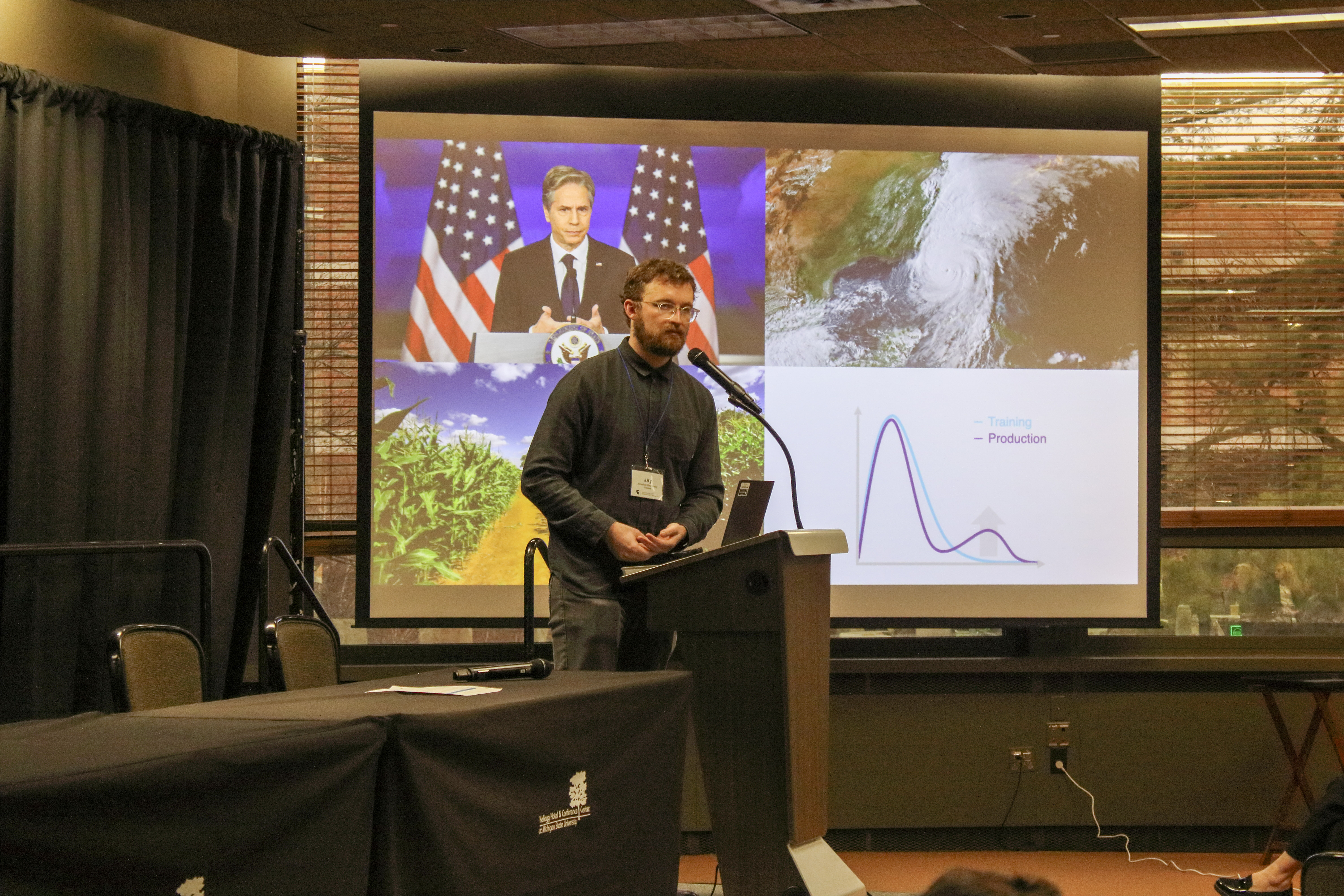
Jay presenting research at the 2026 WaterCube NRT Annual Retreat and Symposium.
Revolinsky’s research focuses on making generative AI systems more flexible so they can work with different kinds of data and be applied to real-world problems. Through the WaterCube, he is extending these methods to applications like weather forecasting, analyzing correlations in Secretary of State speeches, and studying how AI-generated speech affects people’s opinions about food and travel choices.
Because of his training, Revolinsky approaches interdisciplinary work from the ground up. “It’s a very bottom-up thinking process,” he said. “How do I bridge from data science at the bottom of the pyramid, all the way up toward water and social science to make it interesting, applicable, or to have some sort of meaning.”
His collaborations have grown directly or indirectly from his involvement in the WaterCube. They include work with the Geography Department on species distributions in Alaska, with political science on the effects of Secretary of State speeches on democracy, with the Environmental Science and Policy Program on weather forecasting and climate-disaster opinions, and on how AI-generated speech influences grocery and travel decisions.
Revolinsky values the WaterCube program’s brown-bag meetings and the steady flow of ideas that come from working across disciplines. “There’s no shortage of it,” he said.
For students considering the program, Revolinsky’s advice is clear: “It’s going to do far better than it’s going to add work.” Engaging outside of one’s core field shifts the focus from making technology more powerful to asking “How can I help?” That change, he finds, makes the work more interesting and more useful for solving real-world problems.